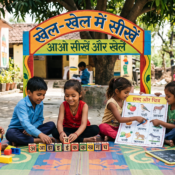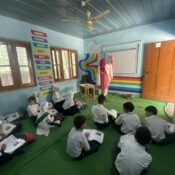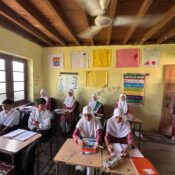

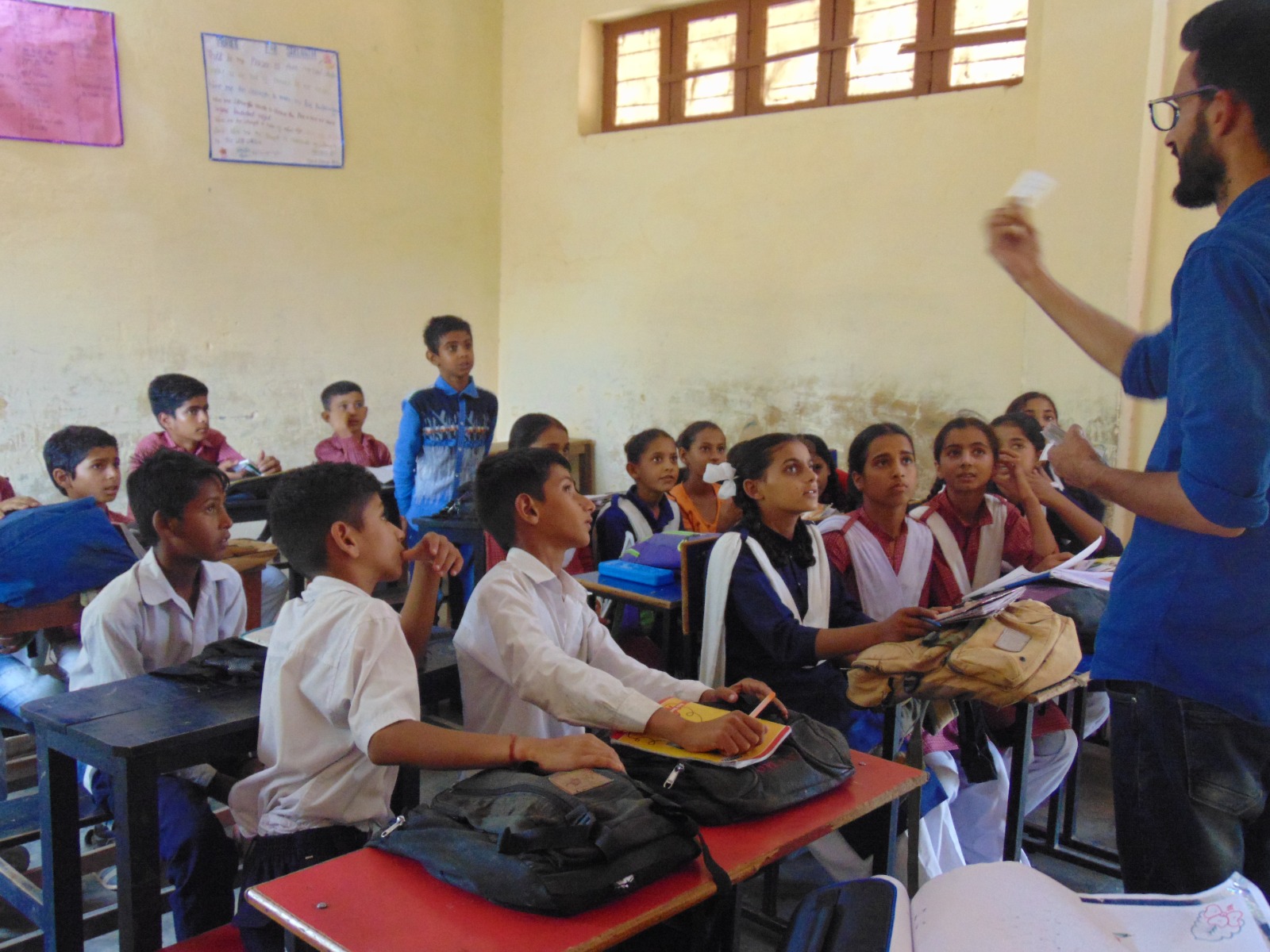
My understanding of Early Childhood Care and Education (ECCE) did not begin in a lecture hall. It began on the ground – in the small, modest rooms of Anganwadi Centres and pre-primary classrooms across Jammu & Kashmir. I still remember walking into one such centre where children sat on old mats, some humming softly, others waiting quietly for the mid-day meal. The Anganwadi worker was doing her best, stretched thin between nutrition delivery, record-keeping, and countless other duties, but there was little space left for structured learning. In schools the picture was a little brighter – colorful charts on the walls, children gathered in circles – yet even here, the methods and playful materials that young learners need were often missing.
And yet, the gaps were not what stayed with me. What stayed were the sparks -a child’s curiosity as they stacked stones into a tower, a teacher turning bottle caps into counting tools, a parent watching proudly from the doorway. These small, ordinary moments carried an extraordinary truth: the potential was always there, waiting to be nurtured. Each child’s smile, each question asked, was a quiet reminder that learning is not confined to textbooks; it lives in play, exploration, and relationships.
It was only later that I came across Heckman’s Curve, a concept in developmental economics that gave words to what I had already sensed. Nobel laureate James Heckman showed that the returns on investment in human capital are the highest in the earliest years of life, from birth to age five. This is when the brain is most adaptable, when every word, sound, or gesture builds pathways for lifelong learning. Invest early, and the benefits ripple across education, health, and even economic productivity. Delay, and not only do outcomes suffer – the cost of catching up becomes far higher. The research was fascinating, but it also felt deeply personal. It was like seeing a scientific reflection of the tiny sparks I had witnessed firsthand.
Seen through this lens, my visits made even more sense. ECCE in J&K today works through two systems: Anganwadis under ICDS that bring nutrition, health, and early learning together, and pre-primary classes in government schools under the Education Department. Both have strengths – ICDS has improved nutrition and immunisation, while schools bring children into the fold of formal education earlier. But both also have gaps. Anganwadis often lack trained educators and playful, child-friendly spaces. Schools may have infrastructure, but not always the specialized training or tools suited to the youngest learners. Sometimes, I observed classrooms full of charts and alphabets, but children were simply copying letters rather than engaging with them meaningfully. The learning was there, but the joy of discovery was often missing.
The science is clear. The early years are not a waiting room for “real schooling.” They are the foundation of everything that follows. Effective ECCE means safe, stimulating spaces; teachers who understand how young children learn; playful, language-rich environments; and parents who are engaged in the journey. These may sound simple, but they are the building blocks of human potential. Even small interventions -a story told with expression, a game that teaches counting, a teacher noticing a child’s unique curiosity – can have ripple effects that last a lifetime.
The way forward lies in bringing the strengths of both systems together – the nutrition and health focus of ICDS with the structured learning environment of schools. Strengthening teacher training, creating playful classrooms, ensuring quality materials, and recognizing early childhood education as a professional field in itself can together make a lasting difference. Communities, too, have a role: encouraging parents to engage with children through storytelling, songs, and play. A child’s first teacher is often the parent or caregiver, and empowering them is just as critical as equipping formal educators.
For me, ECCE is not just a policy idea. It is the sparkle in a child’s eyes when they recite a rhyme. It is the creativity of a teacher making learning from the simplest of objects. It is the quiet resilience of a parent who dreams of a brighter tomorrow for their child. Heckman’s research only confirmed what these moments had already taught me: “‘early learning begets later learning, and skills beget skills”. There is no substitute for investing in these formative years, and no shortcut around the need for quality, empathy, and attention.
The question now is not whether we should invest in ECCE – it is how each of us, as families, teachers, and communities, can make those early years joyful, meaningful, and full of discovery. Because when we nurture the youngest among us, we are not just shaping their lives. We are shaping the future of Jammu & Kashmir – one spark, one story, one child at a time.